Last updated: 16 May 2026
Comparing NBN plans is harder than it should be. Every provider names their tiers differently, uses their own marketing language, and buries the important numbers in fine print. This guide walks through how to compare plans properly, what each piece of information actually means, and how to spot the gotchas.
If you haven’t decided whether NBN is the right type of connection for you (versus 5G home wireless or Starlink), start with our how to choose an internet plan guide or the broader NBN vs Broadband vs Wireless overview.
The short version: four steps to choose an NBN plan
- Find your NBN connection type at nbnco.com.au — this determines which speed tiers you can actually use.
- Pick a speed tier based on your household size and how you use the internet.
- Compare plan listings from a few providers at that speed tier, using the same metrics.
- Shortlist 2–3 plans in your budget. Pick the one with the best typical evening speed and Australian support.
The rest of this guide goes into each step in detail.
Step 1: Know your NBN connection type
Your address is on one of seven NBN connection types: FTTP, FTTC, FTTN, FTTB, HFC, fixed wireless or Sky Muster. The type you have determines which speed tiers are physically available to you.
- FTTP and HFC support every speed tier up to NBN 1000 (and NBN 2000 on FTTP).
- FTTC supports up to NBN 250.
- FTTN and FTTB are capped at NBN 100, and on long copper runs you may not even get full NBN 50.
- Fixed wireless supports up to NBN 100 in most areas after the 2023 upgrade.
- Sky Muster supports up to 50 Mbps on Sky Muster Plus.
Check your address on the NBN Co address checker first. Paying for an NBN 250 plan when you’re on FTTN is throwing money away. Our guide to the different types of NBN connections explains each one in detail with diagrams.
Step 2: Pick a speed tier
The standard NBN speed tiers and typical 2026 prices:
| Speed tier | Download | Upload | Typical 2026 price | Best for |
|---|---|---|---|---|
| NBN 25 | 25 Mbps | 5 Mbps | $55–$70/mo | Singles, light browsing, HD streaming |
| NBN 50 | 50 Mbps | 20 Mbps | $70–$85/mo | Most families, work-from-home |
| NBN 100 | 100 Mbps | 20 Mbps | $80–$100/mo | Larger households, 4K streaming, gaming |
| NBN 250 | 250 Mbps | 25 Mbps | $100–$120/mo | Heavy users (FTTP/HFC only) |
| NBN 1000 | 1000 Mbps | 50 Mbps | $110–$130/mo | Power users (FTTP/HFC only) |
| NBN 2000 | 2000 Mbps | 100 Mbps | ~$200/mo | Edge cases (FTTP only) |
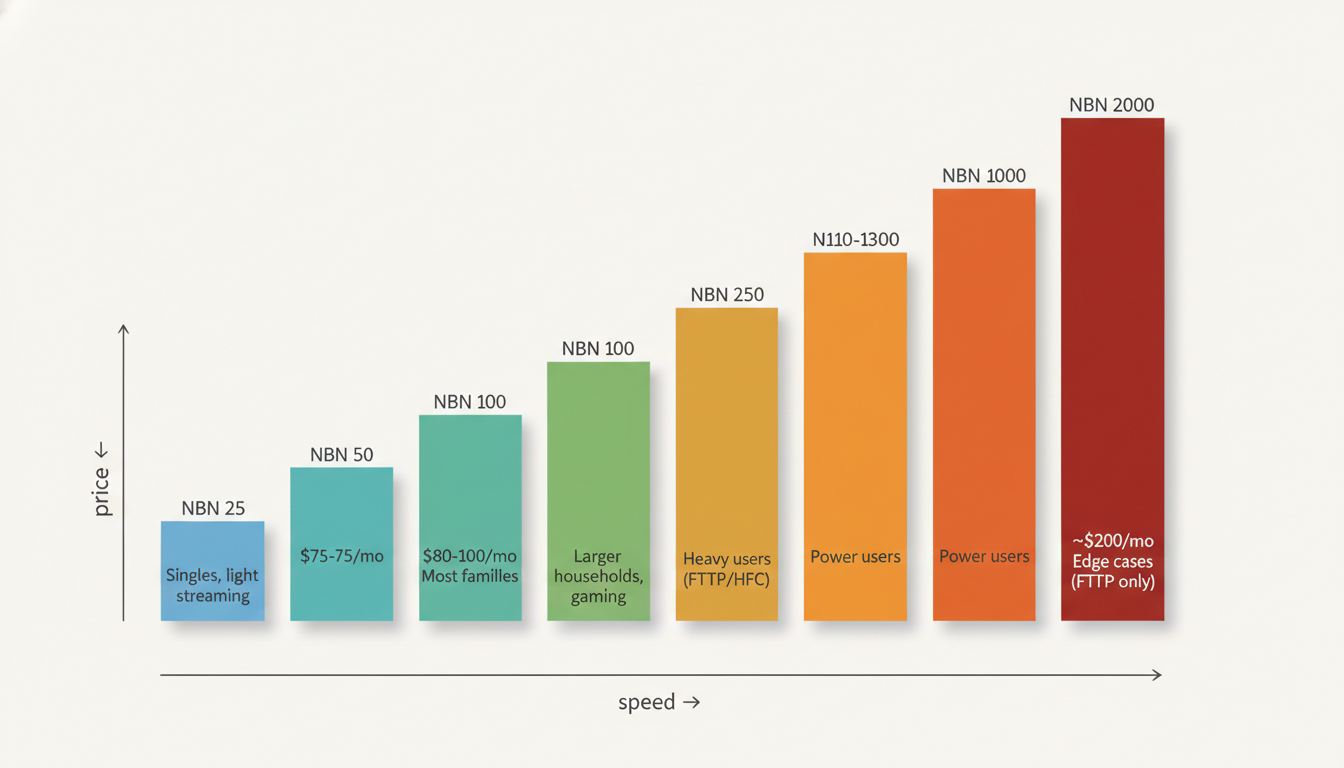
About half of Australians end up on NBN 100. NBN 50 is enough for most families. NBN 25 works fine for one or two light users. Anything above NBN 100 is overkill unless you specifically need it.
A practical rule: pick the slowest tier that meets your peak needs. You can always upgrade later. Most providers let you change tiers month-to-month with no penalty.
Step 3: Decode the plan listing — what each number means
Different providers display their NBN plan information in different formats, which makes side-by-side comparison painful. Here’s what every piece of information actually means.
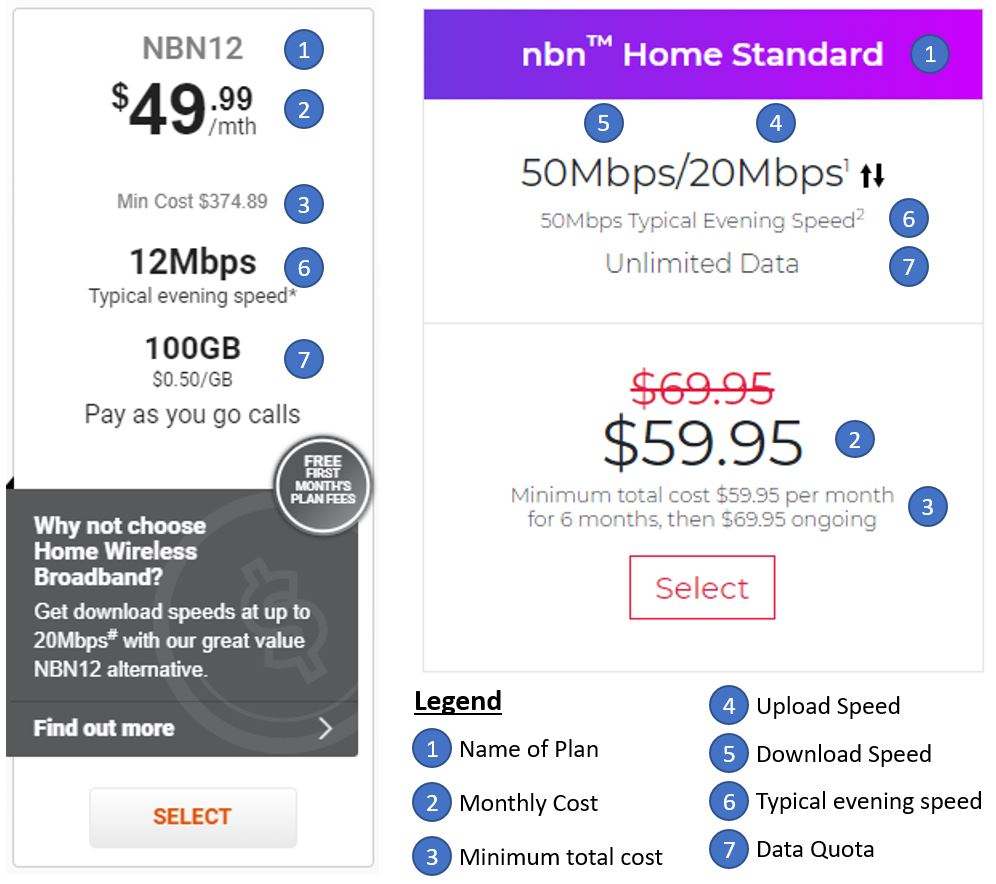
- Plan name — Some providers use the standard NBN name (NBN 50, NBN 100). Others use their own naming system (Gold, Silver, Bronze, “Family Plus”). Write down the speed tier and ignore the marketing name.
- Monthly cost — How much you pay each month. Watch for introductory pricing: many providers offer 6 months at a discount, then jump to a higher ongoing rate. Always look at the ongoing price, not the discounted intro price. Our internet plan finder calculates the average over 2 years to make this comparison easier.
- Minimum total cost — How much you’ll pay if you sign up and then cancel. Includes setup fees, modem fees, and contracted minimum monthly payments. A “free modem” with a 12-month contract usually means you pay a modem cancellation fee if you leave early.
- Upload speed — How fast data goes from your house out to the internet. Lower than download speed on every standard NBN tier. Matters for video calls, live streaming, cloud backups and online gaming.
- Download speed — How fast data comes from the internet into your house. The headline number on most plans.
- Typical evening speed — The speed you actually get between 7pm and 11pm, when everyone is online. This is the most important number on the page. The maximum download speed is the theoretical ceiling; typical evening speed is the real-world floor on a busy night. The ACCC publishes quarterly speed reports and providers usually disclose their numbers on the plan page.
- Data quota — How much data you can use per month. Almost every NBN plan in Australia is unlimited now, so this is rarely a deciding factor. The exceptions are mobile broadband plans, Starlink Roam, and some very cheap 4G/5G plans.
Step 4: Compare like-for-like
The trick to comparing plans fairly is to fix the speed tier and compare on price + typical evening speed + extras.
A practical comparison process:
- Choose your speed tier (Step 2 above).
- Open 3–5 provider websites in tabs (or use our comparison tool).
- Note the ongoing monthly price (not the intro discount).
- Note the typical evening speed each one quotes.
- Look at contract length, setup fees, and whether a modem is included.
- Check whether support is Australian-based — our Australian-based tech support providers guide lists the current providers with onshore support.
The winner is usually the plan with the highest typical evening speed in your price range from a provider with decent support. Counterintuitive but true: the cheapest plan is often the worst value because the provider scrimps on network capacity, leading to slow evening speeds.
What’s the cheapest NBN plan in 2026?
This is one of the most common search queries on this topic, so worth a direct answer.
The cheapest unlimited NBN plans in 2026 generally come from Tangerine, Exetel and SpinTel. Entry-level NBN 25 plans run around $50–$55/month ongoing, NBN 50 plans around $65–$75/month. Pricing moves around so this is best treated as a starting point, not a final answer.
For the current list with provider names, evening speeds and any current promos, see our 10 cheapest unlimited NBN plans guide. Updated regularly.
What’s the fastest NBN plan?
Aussie Broadband, Superloop and Swoop usually top the ACCC’s typical evening speed reports on NBN 100 and NBN 1000. Speeds change quarter to quarter, so we track the current numbers in our fastest NBN plan available guide.
If your address supports it, NBN 2000 is the absolute fastest residential tier. It’s currently offered by a small handful of providers (mostly to FTTP addresses) at around $200/month.
Gotchas — what to watch out for
These trip people up every year:
- Introductory pricing. $59/month for 6 months, then $89/month after. Always check the ongoing price.
- “From $X” wording. Usually the cheapest tier; the tier you actually want is often $20–$40 more.
- Setup fees. $99 or $149 hidden in the fine print.
- Modem cost. “Free modem” usually has a contract attached. Leave early and you pay the modem fee.
- Speed tier mismatch. Paying for NBN 100 on a poor FTTN line will give you NBN 50 speeds. Check what your address actually supports before paying for a fast tier.
- Static IP, voice services, content filters. Only pay if you actually need them.
- Contract length. Most NBN plans in 2026 are month-to-month. Avoid 12 or 24-month contracts unless the discount is genuinely significant.
- Auto-renewing promos. Some providers’ “first 6 months at $X” deals will silently renew if you call to cancel and they re-offer. Always confirm the ongoing rate in writing.
Use the plan finder
If you don’t want to compare manually, our NBN plan finder asks a few questions about your household and shortlists matching plans. The side-by-side comparison tool lets you stack plans against each other on price, speed and features.
Both pull from the same data, just present it differently.
What about modem and setup?
Two practical questions to answer once you’ve picked a plan:
- Should I get the provider’s modem or BYO? Most providers offer a modem (often “free” with a 12-month contract, otherwise $99–$200 outright). You can BYO if you already have an NBN-compatible modem — see our BYO modem setup guide.
- How long until I’m online? 1–5 business days if the address is already active, 1–2 weeks if it’s NBN-ready but inactive, 2–3 weeks for a new connection. Our how to connect to the NBN guide walks through the whole process.
Frequently asked questions
What’s the cheapest NBN plan in 2026?
Entry-level NBN 25 plans from Tangerine, Exetel and SpinTel typically run $50–$55/month ongoing. Cheaper plans appear occasionally with new market entrants. See our 10 cheapest unlimited NBN plans for the current list.
Who is the best NBN provider in Australia?
“Best” depends on what you value. Aussie Broadband, Superloop and Swoop generally have the highest typical evening speeds (per ACCC reports). Telstra has the broadest coverage and bundles. Tangerine and Exetel are the cheapest. Internode and Aussie Broadband have the best Australian based support.
Do I need NBN 100 or is NBN 50 enough?
NBN 50 is enough for a family of three or four with normal use (streaming, video calls, web browsing). NBN 100 is worth it if you have multiple 4K streams running at once, gamers in the house, or do lots of large file uploads.
Are NBN plans contract-free in 2026?
Most are, yes. Some bundled plans still have 12 or 24-month contracts in exchange for a modem or upfront discount. Always check before signing.
How do I switch NBN plans without losing internet?
Most providers handle this smoothly. The new connection activates within hours of the old one being cancelled. You can switch within the same provider (just change tier) or between providers. Month-to-month plans have no termination penalty.
Should I bundle phone with my NBN plan?
Only if you actually use a landline. Most providers offer optional VoIP (a phone plug on the modem) for $10–$15/month. If you only use mobile, skip it.
Can I get a plan with Australian-based support?
Yes. Aussie Broadband, Internode, Belong, Aussie Broadband resellers, and a few others have full Australian based call centres. See our Australian based tech support providers guide.
For the broader context: see our hub on NBN, broadband and wireless internet. To find an actual plan: try the NBN plan finder or side-by-side comparison.